
She’s like a spirit that’s sprung up from a happy chance encounter. An eternal, naive innocence, never to be mated, floats around her like spores in spring.
Murakami, Kafka on the Shore
Kafka on the Shore reminds me of that old TV show LOST. Murakami introduces us to talking cats, fish raining from the sky, kids mysteriously falling unconscious, animal torture, long dissertations on classical music, ghost sex, maternal incest, dream rape, more incest, and too many cringe-inducing sex scenes for comfort . . . The book unmistakably falls into the surrealist camp, so these things don’t necessarily need explanation—you read it for the experience—but that didn’t always work for me. His characters, while likeable enough, are motivated by repressed feelings and enigmatic calls of destiny, which reminded me of Stephen King’s The Dark Tower series, but not in a good way.
I’m the lonely voyager standing on deck, and she’s the sea.
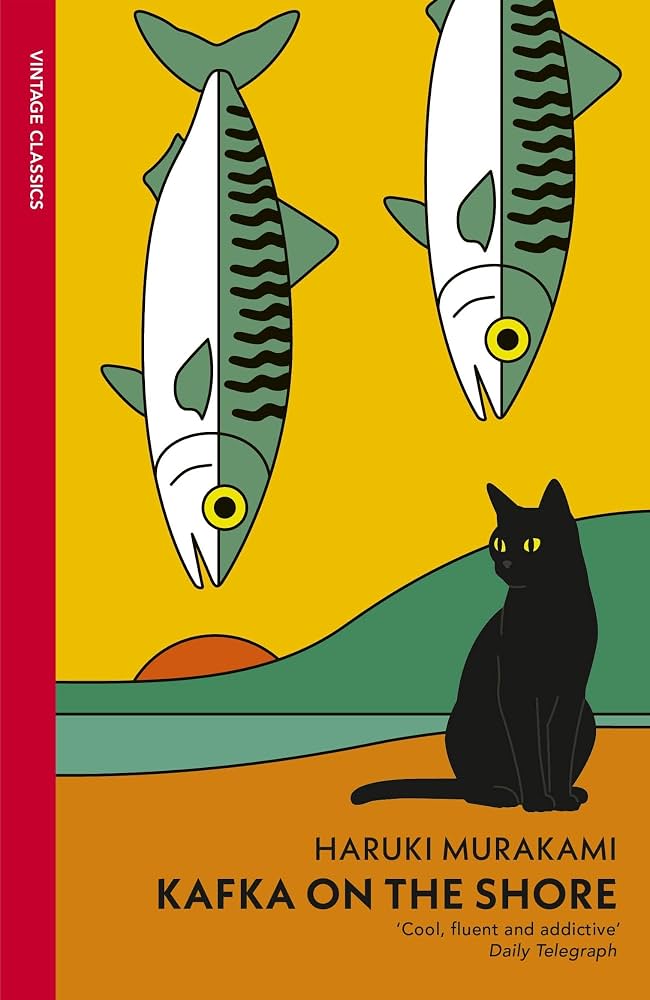
At times, the book is aggressively bad — Murakami seems to me a brilliant author intent on writing the worst story imaginable. He’s like the Picasso of literature. Still bad, but in a fascinating, “WTF-was-he-thinking” sort of way. You keep reading it despite the nonsensical narrative, wanting to know where the hell he’s going with all this, and what drugs he must have been taking when he wrote it. Incoherent chapters are followed by very intriguing chapters, and even achingly beautiful passages, which all becomes frustrating when you sense that, with a bit of editing, and a bit of focus, this could have made for a brilliant novel, even a masterpiece. As is, it’s one of the strangest reading experiences I’ve ever had.
That blank, silent interval between leaves you sad, so terribly sad. Like fog from the sea, that blankness wends its way into your heart and remains there for a long, long time. Finally it’s a part of you.
As you reach the last few chapters, you begin to realize the author isn’t about to explain a damn thing. Why does the main character run away from home at fifteen? Why was his father murdering cats? Why was he fated to sleep with his mother and sister? Did he actually sleep with his sister? Who or what exactly was his father, and what happened to him? Murakami doesn’t care to answer any of the questions he raises—and while I love mystery boxes as much as JJ Abrams, I need to know there’s something inside those boxes. Fiction doesn’t always require explanations, but when it doesn’t, foreshadowing is a must. Let the reader know to expect ambiguity. Here, Murakami spends the first four to five chapters hooking us on a mystery about thirty schoolchildren falling unconscious during World War II, then never brings it up again. It’s as if he got bored of his own story, choosing instead to talk more about classical music and surfing. If you’re looking for surrealism that doesn’t leave you feeling cheated, I recommend Philip K. Dick or Jeff Vandermeer.
Around eleven-thirty two women come in together, wearing identical jeans. The shorter of the two has cropped hair like a swimmer, while the taller woman wears her hair pulled back. Both of them have on jogging shoes, one a pair of Nikes, the other Asics. The tall one looks around forty or so, with glasses and a checked shirt, the short woman, a decade younger, is wearing a white blouse.
If I had to reduce Kafka on the Shore to a single sentence, it would probably be “a philosophy student’s wet dream,” the kind I might have had at fifteen, before I grew up and learned certain fantasies exist only in the minds of adolescent teens. But hey, at least it’s not formulaic. At least it’s not Dungeon Crawler Carl. Murakami is undoubtedly a WRITER, which is more than I can say for whatever tropey, demographic-driven drivel passes for publication these days. Meeting indie-“authors” at book fairs who struggle to tell me the last book they read, I am starting to appreciate genuine storytellers who’ve mastered the craft more and more, even when their stories, at times, read like word vomit.



Leave a Reply