
The worst grade I ever got in graduate school wasn’t an F or even a zero; it was “crucifixion.” No, I wasn’t strung up on a wooden scaffold to be slowly suffocated. But my professor did write on the back of my paper, “If you submitted this to any historical journal, YOU WOULD BE CRUCIFIED!” I hadn’t done enough research, and I’d made assumptions about what people believed in those days without directly sourcing them. Now, I find Emily Wilson making the same mistakes in her 76-page introduction to The Odyssey.
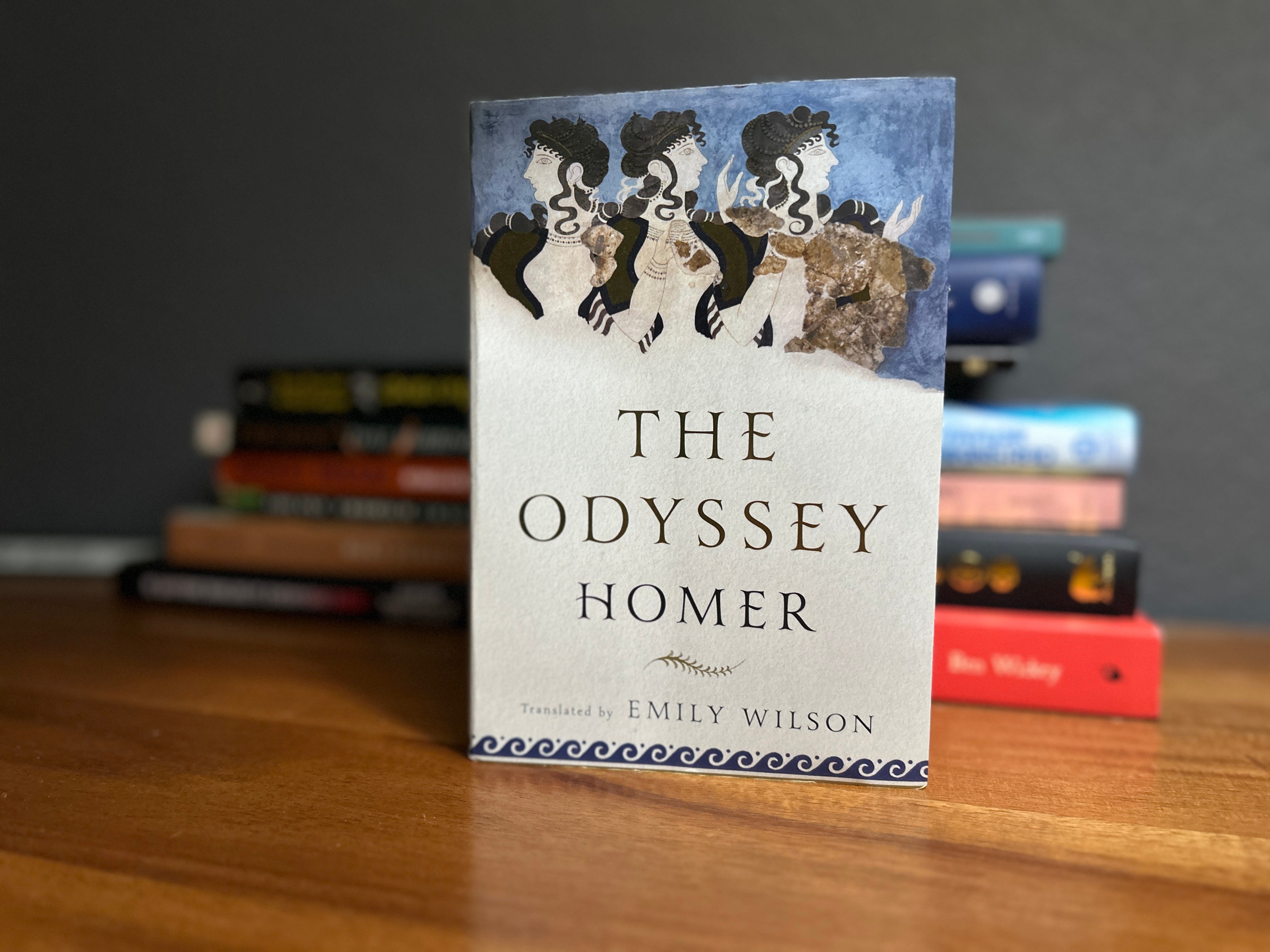
Let me be clear: I don’t begrudge the fact that Wilson is the first woman to translate Homer’s epic. If anything, we need more diverse voices in academia, especially female ones. I also have no qualms with her feminist approach to the material. The Greeks of antiquity were unquestionably sexist, as was every other civilization at the time, though I would argue that The Odyssey, in its frequent veneration of Athena, was more feminist than Christianity and Islam today. And to prove I am not part of the anti-SJW man-so-sphere, I cannot recommend historians Elaine Pagels and Karen Armstrong enough.
That being said, a historian’s job is to be as impartial as possible. History itself, ironically, is full of earlier historians writing from a biased point of view. My professor often lamented how blind even modern academics can be — which is why I was wary of Wilson’s approach to Homer and disappointed in her finding — or inserting — meaning into the text that isn’t there.
To truly understand and appreciate Homer, my professor suggested I learn ancient Greek. No translation, he said, is free of bias. This is something Wilson acknowledges herself. Knowing what life was like 3,000 years ago is impossible, and we all, on some level, impose our own values on the past. The second-best thing a Classics student can do is to study different translations and let the text speak for itself. Even today’s literature is prone to widely divergent interpretations, which is why I disregard commentary altogether, even when it comes from the author. Now this doesn’t mean a historian can’t or shouldn’t provide any insight into the work. I found Wilson’s comparisons between Homer and 19th-century oral poets enlightening. But describing the murdering of Odysseus’s female slaves as “quasi-sexual” is beyond the purview of the historian and something, I imagine, my professor would have “crucified” me for. I do agree, however, with her removing terms like “slut” and “whore” used by earlier translators, since those words did not appear in the original text. But her use of “slave” in place of “maidservant” is debatable, since the term did not carry the same weight as it did in 18th-century America. We know the Founding Fathers slept with their slaves, but Thomas Jefferson didn’t throw lavish parties to celebrate the wedding of his slave-born son, as Menelaus does in Book 4. Clearly, there is no perfect English translation for “slave” from the ancient Greek. Butler uses the term “bonds-woman” instead.
Where I take issue with Wilson is with what she suggests is Odysseus’ desire for patriarchal power and the belief that subservience to a woman, even to a beautiful goddess like Calypso, is emasculating. As Wilson writes:
Leaving Calypso is thus not only a choice to accept mortality and impermanence, but also, incompatibly, a choice to insist on the fantasy of permanent patriarchal dominance over a carefully regulated human household.
If we are not allowed to attribute to Odysseus modern values like love, why does Wilson so readily suggest other qualities such as greed and lust for power? Is the modern world not rife with power-mad moguls like Trump and Musk? Wilson’s interpretation here comes across as overtly cynical, which might explain why, in her review of Nolan’s film, she is baffled as to why Damon’s Odysseus would have wanted to go home and why Penelope pined for his return. Even in Nolan’s modern retelling, love is too naive an explanation, apparently.
While notions of romance have changed significantly over the centuries, and marrying purely for love is relatively new, if not made popular by medieval authors, romantic love as we understand it was not uncommon in ancient Greece. The word ἔρως, from which we derive the word “erotic,” was used to mean romantic love, and was distinct from ἀγάπη, or familial love. And as any anthropologist can tell you, emotional bonding between the sexes offers an evolutionary advantage. Females whose partners abandon them early in the relationship are less likely to survive to raise their offspring. Hell, even dogs have been proven to love us, just as Odysseus’ dog, Argos, demonstrates in the book. Curiously, Emily neglects to mention Argos’ love for his master.
Given what we know of ancient Greek society, I am hard-pressed to believe Odysseus’s longing for home was driven by his need to ‘assert patriarchal dominance’ over his household. ‘Divine order,’ the passing of authority from God to husband, as mentioned in the Bible, was less prevalent in ancient Greece, nor were there any god-kings (though many heroes, like Achilles, claimed divine ancestry). We see god-kings in Ancient Egypt and Persia, but in Homer, Agamemnon falls victim to the gods like any other mortal. This idea of “hubris”—that even kings are subject to divine judgment—led to the Spartan oligarchy, wherein Leonidas was regarded as the “first among equals,” and later to Athenian democracy.
‘Longing for home,’ or “νόστος/nostos,” is a recurring theme in Greek literature and remains a deeply rooted part of our culture, and I don’t find it all that unreasonable that Odysseus should choose Ithaca over an immortal life with Calypso for this reason. At least, this is how Greeks understood the myth for centuries. It may not have been so much for Penelope’s sake (this is a modern take), but rather his pining for home. Wilson’s translation demonstrates this when Odysseus longs to see even the smoke rising from his island.
Artists like Christopher Nolan are free to interpret the text however they want, and if Emily were a storyteller, I would have applauded her feminist retelling. Instead, she writes as a historian while occasionally blurring the lines between editorializing and interpretation. Again, I find this perplexing because she later acknowledges how earlier translations reflected the values of the cultures that produced them.
As for the poem itself, this is the third version I’ve read so far (after Butler and Fagles), and while it can seem a bit breezy, Wilson’s simpler style better captures Homer’s lyrical, plain-spoken quality. As she puts it, the archaic English used in past translations is no closer to Homer than our modern dialect, although some of the idioms she uses, like the Nordic term “scot” in “scot-free,” are a bit too anachronistic for my tastes. I’ve taken a similar stance on Shakespeare, who, contrary to popular belief, wrote for both the uneducated masses and the well-read aristocracy, and who enjoyed silly puns and bloody action scenes. This is also why I’ve lately moved away from the faux-Old-English style imitated by other fantasy authors. Slang terms, shorthand, and inside jokes were as common to people of antiquity as they are today; removing them doesn’t make your story any more realistic, just more pompous.
Wilson understands the need to appeal to modern readers, which is why her scathing review of Nolan’s film baffles me. She calls Damon’s Odysseus a shallow “action hero,” and that she would be embarrassed to have written any part of the script. Similar criticisms were directed at Peter Jackson’s much-lauded The Lord of the Rings trilogy by JRR Tolkien’s son, Christopher. There’s just something about “action,” “fun,” and “adventure” that academics love to hate on. It is a bias authors have been struggling with for generations. Fahrenheit 451 author Ray Bradbury had to defend Sci-Fi from the literary snobs who thought the genre beneath them. Period dramas, to this day, more often win Oscars for Best Picture, even when superior genre films are nominated. This is why I avoided earning my master’s in literature, because my stuffy PhD professors couldn’t appreciate the kinds of fiction people actually want to read. (My English teacher hated fantasy if not written by Poe or Shakespeare).
The Odyssey is not only one of the earliest works of literature, but also the mother of all speculative storytelling. To disregard its influence on Sci-Fi and fantasy is to miss, perhaps, the greatest part of it. Without the more thrilling aspects of Homer’s poem, without the Cyclops, Circe, or the Sirens, we’d be left with a moody drama as popular as the plays of Eurypedes. Homer (and Odysseus, in talking with the Phaeacians) understood this better than most Classicists today. He understood the need for spectacle and igniting the imagination, for “bread and circuses,” as the Romans put it. And Nolan does too.
Thankfully, Wilson lets Homer do the talking (or should that be singing), leaving the magic of the story intact. As for her introduction, my professor let me rewrite my paper for a B+, and I think that, with a bit of tweaking, Wilson’s intro could earn the same grade.


Leave a Reply